Terry Fox · Behind the Glass
Terry Fox artifacts held in the Permanent Collection. The Museum will not relinquish them.
← The Museum ArchiveThe Wristband You Can't Take Off
Terry Fox, my grandmother, and the summer in Toronto that set the course of my life.
My grandmother was my person. Margaret Beryl Radford, née Barden. We called her Ma. She was a war bride. At 17 years old, my grandfather lied about his age to enlist in the Canadian Army to go overseas in the Second World War. While stationed in England, he met her, married her, and brought her home. When I was small, we went to live with them. That was the year she was diagnosed with breast cancer.
At ten, you don't understand what that word means. You only know it's terribly frightening.
That same spring, a young man from Port Coquitlam, British Columbia dipped his artificial leg in the Atlantic at St. John's, Newfoundland, and started running west. Terry Fox called it the Marathon of Hope. Every night we watched him on the news. Every morning I cut his stories written by Leslie Scrivener, out of the Toronto Star and pasted it into a scrapbook. When he came through Scarborough, we were in the crowd at the Civic Centre. I don't have a photo to prove it. I just remember it.
Scarborough, July 11, 1980. Film: The Terry Fox Foundation.
Their journeys ran side by side. On September 1, outside Thunder Bay, Terry stopped running. The cancer had come back, in his lungs. Ma was still in the hospital, recovering from her surgery. He died the next June. She didn't outlive him by long.
He is a big part of why I went into medicine, and then into surgery. Early in my career, much of my practice was treating breast and colon cancer.
I've run a few marathons. I still can't understand how he did it: close to a marathon a day, on one leg, for 143 days and 3,339 miles.
Around 2004, everyone was wearing rubber wristbands against cancer. I wanted one that couldn't come off when the cause went out of fashion. The next spring, I rode my motorcycle to Terry's grave in Port Coquitlam. His headstone carries an image of him running early in the Marathon of Hope, in the cold of the Maritimes, a sweatshirt under his T-shirt. Standing there, I knew what I wanted. Not that image, but Terry later in the run, in summer in Ontario, in his Marathon of Hope shirt, still going. I had it tattooed on my right arm, twelve inches tall. The ultimate wristband.
The photograph on my arm. Image: The Terry Fox Foundation.
That September, the Toronto Star, the same paper I clipped as a boy, wrote about it. I had met Leslie Scrivener, and she loved the tribute to Terry and the story behind it. She invited me to the Star to have my tattoo photographed for the story she wrote. I told her then what I still believe: when I think I'm having a bad day, all I have to do is look at my right arm, and everything's put in perspective.
Leslie Scrivener, "Two Indelible Tributes: A graveside visit leads to an epiphany," Toronto Star, Sunday, September 18, 2005, page D12.
In 2013, I ordered a limited-edition metal print of Terry running at night, and it shipped to our address in Jersey City. Someone noticed. Terry's sister, Judith, reached out to ask whether there was a story behind it. I told her all of it. Then I sent her a photo: me, my tattoo, my infant son Christian in my arms, and Terry running on the wall behind us. She loved it. That photo is below.
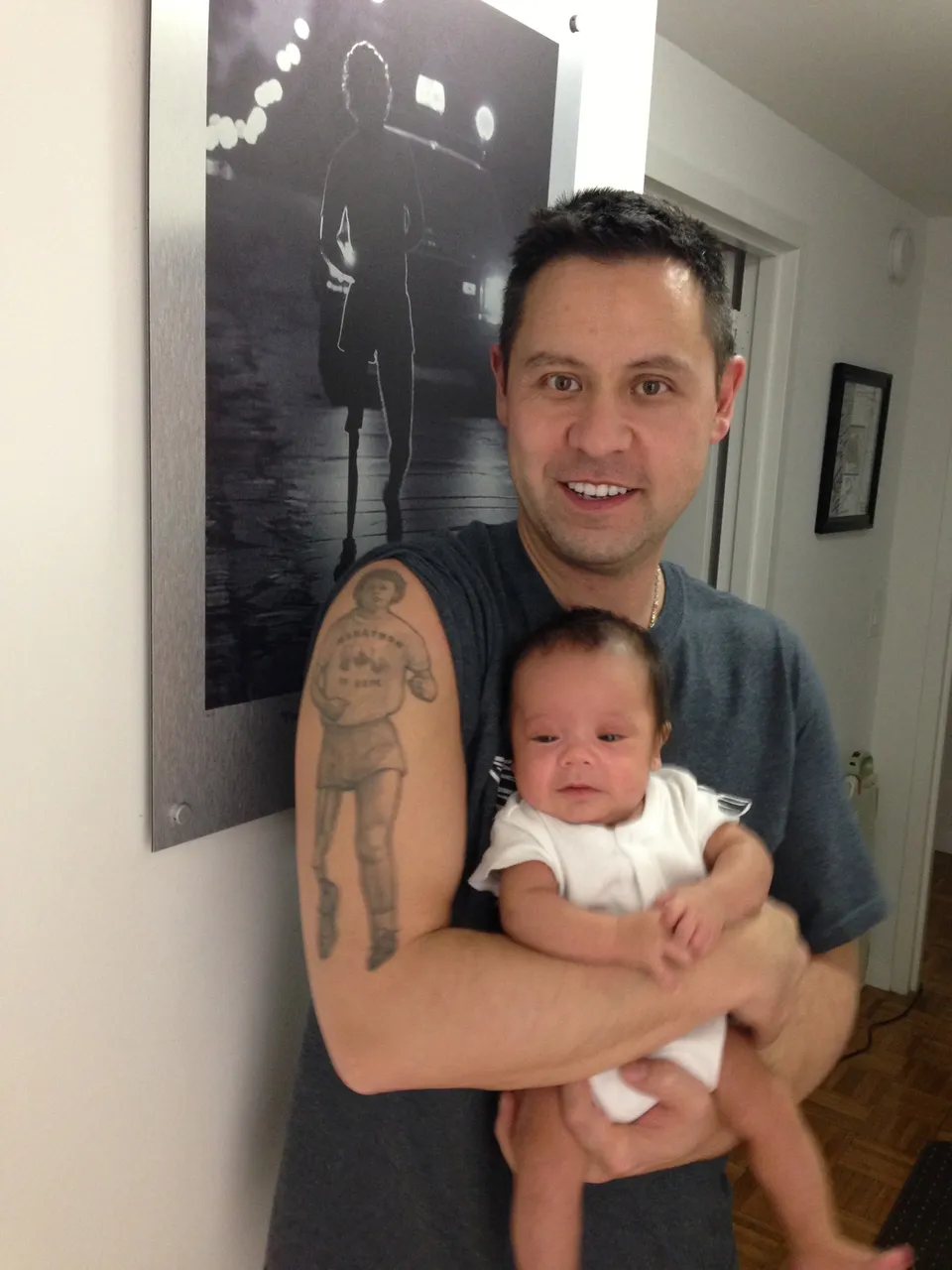
Terry Fox tattoo, with Terry running on the wall behind, and Christian
These cards are 2011 In The Game Canadiana, #88, from the Hero subset: Terry on the road during the Marathon of Hope. We keep three Ruby and one Sapphire, listed at print runs of 180 and 50. They aren't signed. They aren't graded. They will never be offered.
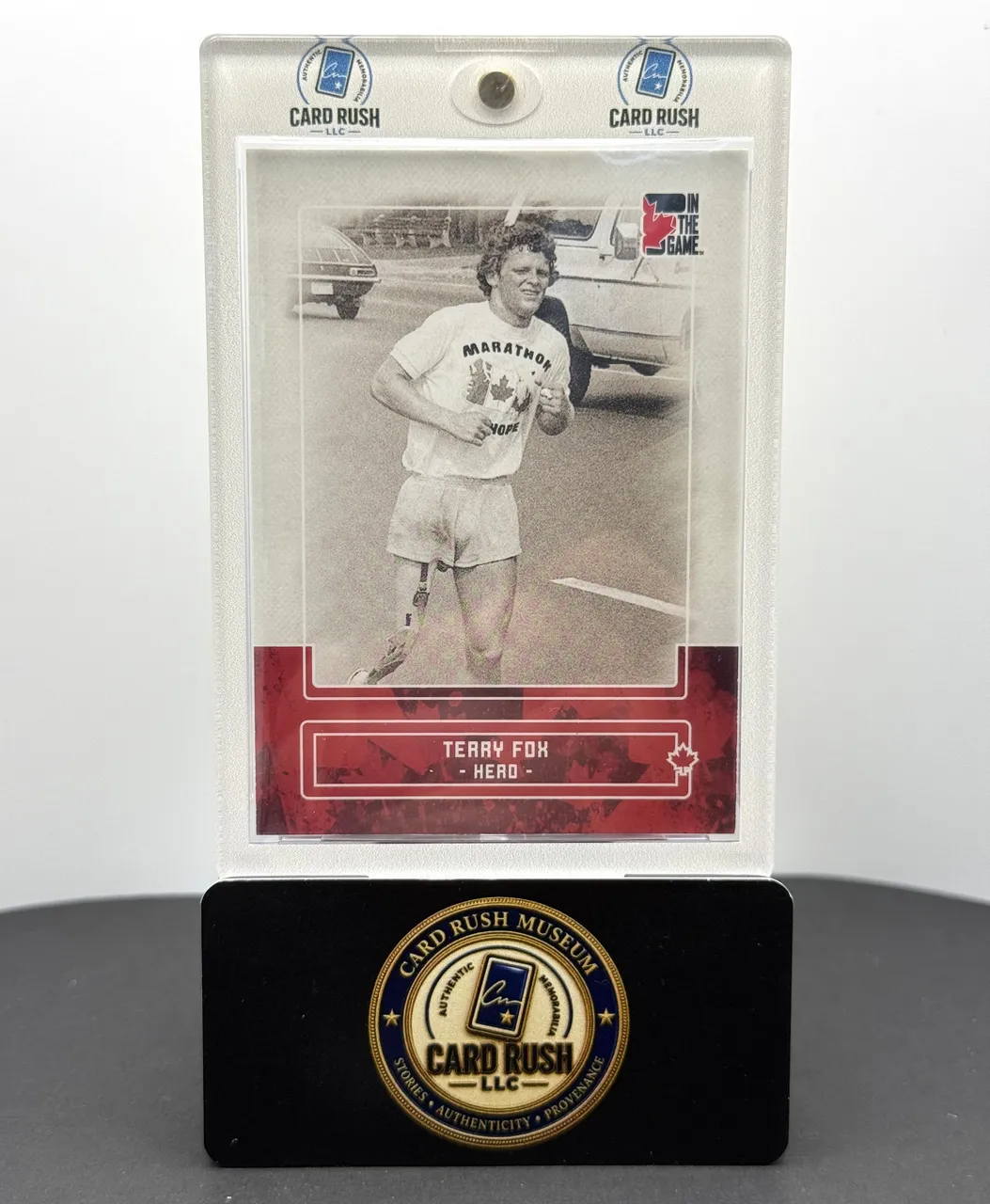
He never finished the run.
Nearly fifty years later, he's still running with me.
Film: The Terry Fox Foundation and The Tragically Hip.
Terry's story continues at terryfox.org.
Permanent Collection — the Museum will not relinquish this artifact.
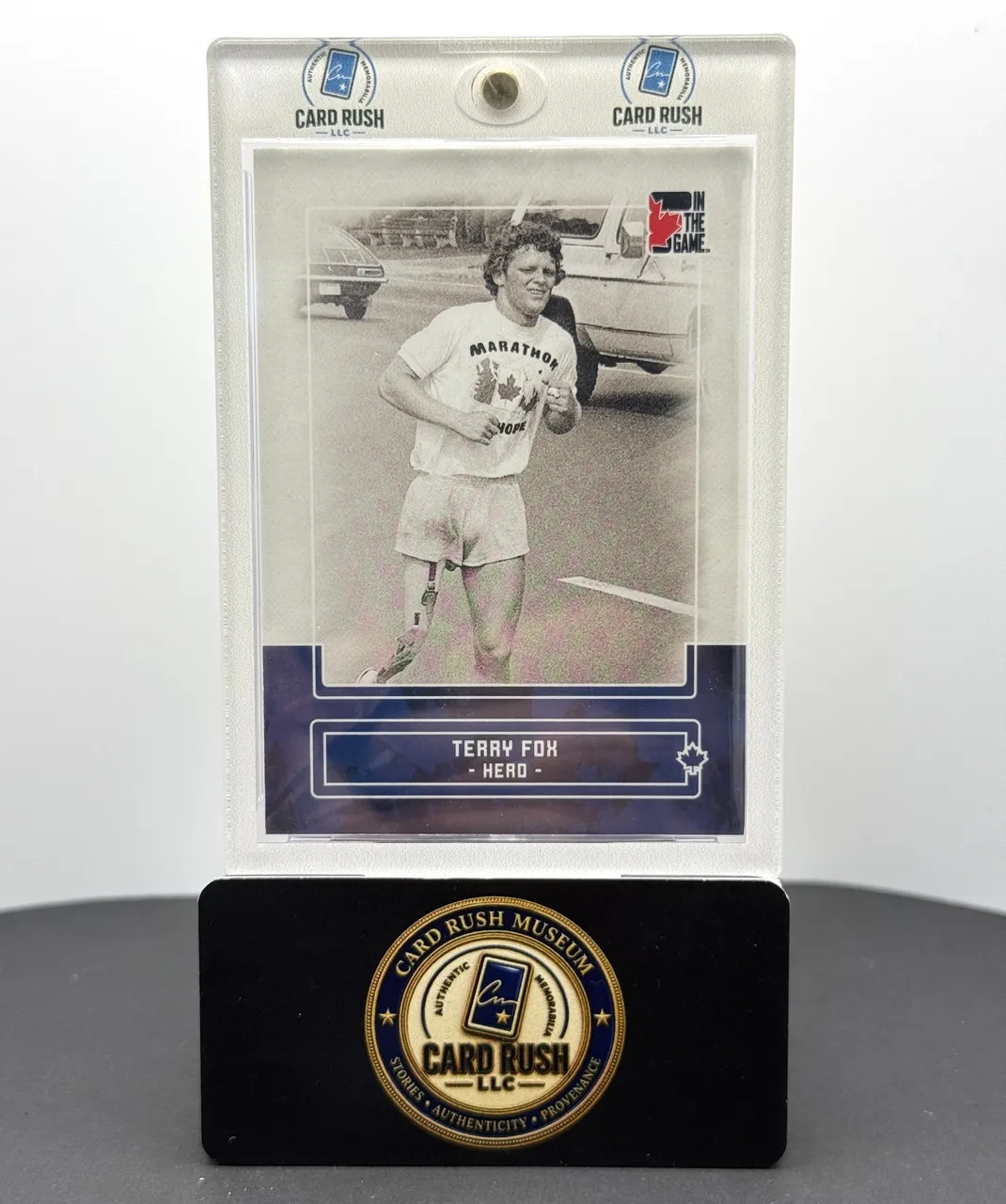
2011 In The Game #88 Terry Fox Hero · Sapphire
Permanent Collection — the Museum will not relinquish this artifact.